
The Art of the Curated Closet: Building a Capsule Wardrobe with Colour Theory
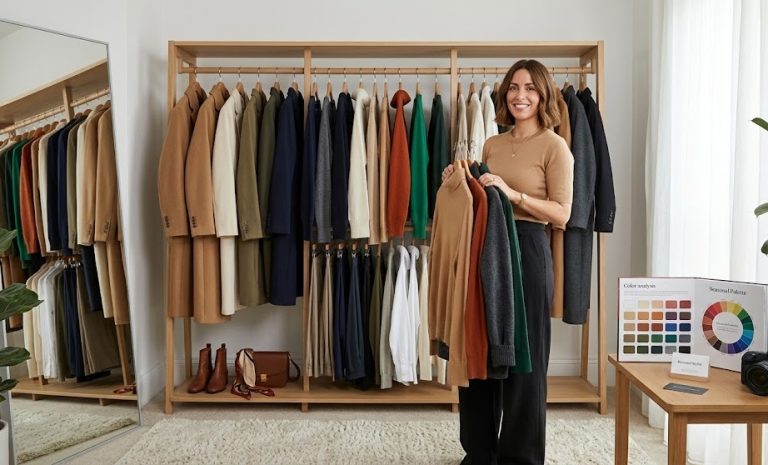
In an era of fast fashion and overstuffed wardrobes, the “capsule wardrobe” has emerged not just as a trend, but as a sustainable lifestyle choice. For many consumers, the challenge isn’t having enough clothes—it’s having too many items that simply don’t “talk” to each other.
As a personal stylist, I see this daily: a wardrobe full of beautiful individual pieces that result in a “nothing to wear” crisis every morning. The solution lies in the strategic marriage of minimalism and the scientific principles of Colour Analysis.
Why Colour is the Foundation of a Capsule
A capsule wardrobe is a collection of a limited number of essential items that can be mixed and matched to create a wide variety of outfits. Without a cohesive colour palette, a capsule fails because the pieces remain “islands.”
By using your personal colour palette—those shades that harmonise with your skin undertone, eyes, and hair—you ensure three things:
Automatic Coordination: Every top goes with every bottom because they share the same undertone (cool or warm).
Skin Vitality: The right colours reduce the appearance of shadows and redness, making you look well-rested without extra make-up.
Reduced Waste: You stop buying “orphan” items that don’t match anything you already own.
Step 1: Identify Your “Base” Neutrals
In the UK, our temperamental climate demands layering, which makes neutrals the workhorse of any wardrobe. Your base neutrals should be your highest-quality investments, such as wool coats, tailored trousers, or blazers.
Cool Undertones (Summer/Winter): If you have a blue or pink undertone to your skin, lean towards Navy, Charcoal, Silver, or a crisp “Optic” White.
Warm Undertones (Spring/Autumn): If your skin has golden or peach tones, look for Camel, Olive, Chocolate Brown, or Cream/Ecru.
The Stylist’s Tip: Black is often seen as the universal neutral, but according to colour theory, it can be too harsh for those with “Muted” or “Light” palettes. A deep Navy often provides the same versatility with a much softer impact on the complexion.
Step 2: Selecting Your “Elevator” Colours
Once you have your neutrals, select two or three “accent” colours from your palette. These are the shades that add personality and “lift” to your capsule.
Research into colour psychology suggests that the colours we wear significantly impact our mood and how others perceive us. For example, Blue is often associated with trustworthiness and calm, while Red can boost confidence and perceived authority. By choosing accents within your seasonal palette, you ensure that even your boldest choices still harmonise with your neutral base.
Step 3: The “Rule of Three” for Proportions
To keep the wardrobe functional, follow a basic ratio. A standard 30-piece capsule usually follows this breakdown:
Core Basics (9 pieces): High-quality neutrals like T-shirts, fine knits, and trousers.
Statement Pieces (6 pieces): Your accent colours—think a bold silk blouse or a patterned midi-skirt.
Outerwear & Layers (5 pieces): Essential for the British weather, including a trench coat, a heavy wool coat, and a versatile cardigan.
Accessories & Shoes (10 pieces): The “glue” that holds the look together, ideally in your neutral or accent metals.
Step 4: Sourcing Sustainably
Building a capsule is an exercise in “buying less, but better.” According to a report by the Waste & Resources Action Programme (WRAP), extending the life of clothes by just nine months can reduce their carbon, water, and waste footprints by around 20–30%.
When shopping for your palette, look for:
Natural Fibres: Wool, linen, and organic cotton hold dye better and last longer than synthetics.
Resale Platforms: Apps like Vinted and Depop are excellent for finding specific “seasonal” colours from high-end British brands at a fraction of the price.
The Result: The “Decision Fatigue” Cure
When your wardrobe is restricted to a specific colour palette, the “Paradox of Choice” is eliminated. Instead of being overwhelmed by infinite combinations that don’t quite work, you are presented with a curated selection where every choice is a “good” one.
You aren’t just wearing clothes; you are wearing a visual identity that feels authentic to you.